
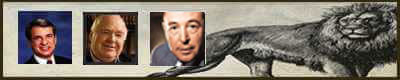


Born in Ireland in 1898, C. S. Lewis was educated at Malvern College for a year and then privately. He gained a triple first at Oxford and was a Fellow and Tutor at Magdalen College 1925-54. In 1954 he became Professor of Mediaeval and Renaissance Literature at Cambridge. He was an outstanding and popular lecturer and had a lasting influence on his pupils.
C. S. Lewis was for many years an atheist, and described his conversion in Surprised by Joy: 'In the Trinity term of 1929 I gave in, and admitted that God was God ... perhaps the most dejected and reluctant convert in all England.' It was this experience that helped him to understand not only apathy but active unwillingness to accept religion, and, as a Christian writer, gifted with an exceptionally brilliant and logical mind and a lucid, lively style, he was without peer.
In 1943 Great Britain, when hope and the moral fabric of society were threatened by the relentless inhumanity of global war, an Oxford don was invited to give a series of radio lectures addressing the central issues of Christianity. Over half a century after the original lectures, the topic retains it urgency. Expanded into book form, Mere Christianity never flinches as it sets out a rational basis for Christianity and builds an edifice of compassionate morality atop this foundation. As Mr. Lewis clearly demonstrates, Christianity is not a religion of flitting angels and blind faith, but of free will, an innate sense of justice and the grace of God.
_________________________________________________________________________
Book I. RIGHT AND WRONG AS A CLUE TO THE MEANING OF THE UNIVERSE
Book II. WHAT CHRISTIANS BELIEVE
1. The Rival Conceptions of God
1. The Three Parts of Morality
4. Morality and Psychoanalysis
12. Faith - Second Sense
Book IV. BEYOND PERSONALITY: OR FIRST STEPS IN THE DOCTRINE OF THE TRINITY
Comments
If you have ever dealt with drastic annihilation of morals in stroke victims you will see that morals that we feel we should follow (but freely ignore a lot of the time) can be wiped out (guilt for having lost these morals is also wiped out) by death of parts of the brain.
It has also been shown that Animals also have moral leanings and animals also have the will to break these natural inclinations (for animals these include monogamy, incest and murder).
In Lewis's time a lot of this was not known.
I guess you could always argue that god acts through evolution to craft favorable morals but god would only loosely refer to some greater leaning towards order in chaos. If you know anything about chaos in the fractal sense you will see that order comes as a direct result of chaos, not the other way around. So is god chaos or the result of chaos(order)? If you believe god is a superpower above all else then he could only be chaos.
http://www.youtube.com/watch?v=XHrvr5deVF8
I guess I can pray for them if nothing else.
I'd rather at least try to be intellectual than rely on god to do it for me.
Humans decide the difference between right and wrong and good and evil and to claim these things are just items that grow on a tree we are forbidden to eat from is just...ridiculous!
It can be hard to grasp for a person just looking for an easy way out of the Christian idea of objective morality. Here's a parallel. When a man loves a woman, his brain patterns change and react. It can be measured. That does not mean that the brain "makes" love. The actions of a person outside of the brain (the lover) is the cause of the emotion of love, and all of its attendant brain patterns.
People losing their capacity for understanding/processing morals through unnatural injury, neither proves nor disproves anything. A dead person, whose body is completely incapacitated, doesn't have any morals at all either. So what? You might as well argue that the entire universe only exists in humans' brains, since we cannot perceive any part of it apart from it being processed through our brains first.
You might as well argue that since some people go blind and can no longer process color, that color is an invention of the brain and the eye and not an objective reality. It's really quite a foolish argument.
"You might as well argue that since some people go blind and can no longer process color, that color is an invention of the brain and the eye and not an objective reality. It's really quite a foolish argument."
Color is a representation our brains use to reference a certain bandwidth of magnetic radiation. Color IS an invention of the brain but the data is real (the real part is the bandwidth the waves occupy...not the color).
So... if all humans died then magnetic radiation would still exist... but morals and color wouldn't. I'm sorry but just because morals are abstract doesn't mean they're not physical.. they are purely physical, like the transistor is the physical part of abstract computer programs in memory. Morals are like the code (which is written by both genetics and external influence... learning). Like the transistor, when a brain cell dies so does morality. Computer programs don't go to heaven so why should our minds along with our morality?
"Brains can think about immaterial things (human brains at least) and they can react to them, but that does not mean that they are the SOURCE of them."
Brains are the source of the ideas/information... but not the raw data/forces. Ideas/information are pure interpretation by the brain and hence immaterial things ARE the direct result of processing in the brain, hence the brain IS the source of information/ideas/objects.. but not the raw data/forces. Raw data (acoustic, magnetic, electric and strong forces) is only real before it hits, for example, the eye. As soon as the human eye converts the light into an action potential it immediately loses all the information the eye cannot physically translate into the action potential. Not only is the brain interpreting the data but it can only rely on lossy and partial data supplied to it by the eye.
"When a man loves a woman, his brain patterns change and react. It can be measured. That does not mean that the brain "makes" love. The actions of a person outside of the brain (the lover) is the cause of the emotion of love, and all of its attendant brain patterns."
Again... love comes from the brain. It is possible for one person to fall in love and not the other. I love my parents not because love is some ghostly vapor floating from them to me. For all I know they may not be my parents at all. Love is an idea and a chemical reaction to that idea, a feeling based again on badly/beautifully TRANSLATED data with influence from genetics and previous idea formation.
"You might as well argue that the entire universe only exists in humans' brains."
If you are talking about the IDEA of the universe then yes... it only exists in our brains. The STUFF outside of us goes on existing but the objects... the separations and labels humans create in their minds vanishes when the mind becomes a disorganized mush of organic compounds (dead).
Sorry I meant subjective.
The only way to be objective is to take measurements using impartial instruments where the only approximation made has to do with resolution/scale limits. At best this is still only pseudo objective.
Ether way making vast vague generalizations about things such as love and morals might leave you content but its going to leave you dazed and confused when you find you are left with nothing more than "good" and "evil" instead of an explanation and a better understanding of why people do certain things.
The one thing I find great about Christianity is the concept of forgiving people. The dissapointment comes when you find yourself forgiving somone who you think is evil... then you get this great sense of being all saint like.. then you find out the reality of things... that person wasnt evil... just misunderstood due to crappy brain translations of reality and you are left not with forgivness but with self hatred, that you have patronised that person and forgiven them for something that is just beyond your capacity to understand.
BTW I'm baptized Christian.... I just don't believe in god or a lot of the things some people take literally in the bible.
Just be aware I am questioning Christianity.... NOT Christians as fellow human beings. Spirituality helps a hell of a lot of people get though life. Better be Christians than doped up on antidepressants.
Much like I don't drink alcohol and I can argue against it, but I don't think people who drink it are bad people at all and they have every right to enjoy themselves.